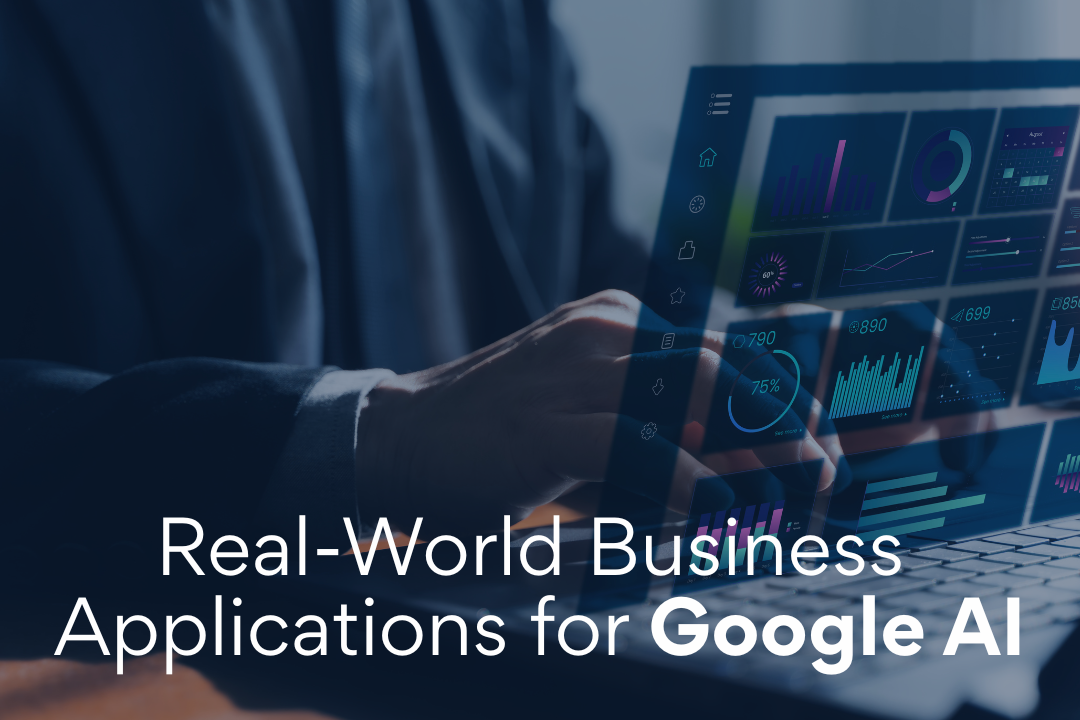

Real-World Business Applications for Google AI

Real-World Business Applications for Google AI

AI adoption often becomes more tangible once it moves beyond technical experimentation and into everyday business operations. Rather than existing as isolated tools, AI capabilities are increasingly being embedded into workflows that teams already rely on for processing information, managing customer interactions, and supporting internal decision-making.

Across the Google Cloud ecosystem, organizations are applying AI technologies in ways that range from document automation and intelligent search to conversational support and operational workflow assistance. Some implementations are customer-facing, while others are designed to improve internal efficiency behind the scenes.

The use cases themselves can vary widely between industries, but many of the underlying goals remain similar like reducing repetitive manual work, improving access to information, and helping systems respond more intelligently to large amounts of data and content.

Document Processing and Information Extraction

Document workflows continue to be one of the more common areas where organizations begin applying AI capabilities operationally.

Teams handling invoices, onboarding forms, contracts, reports, or identification documents often spend significant time reviewing, extracting, validating, and organizing information manually. As document volumes grow, those workflows can become difficult to scale efficiently.

For some teams, the primary goal is operational efficiency. In other cases, faster document processing helps improve response times, reduce delays, or support larger customer-facing workflows tied to onboarding, service requests, or approvals.

Customer Experience Enhancements

AI capabilities are also being integrated into applications that support customer communication and digital experiences. Search functionality, translation services, conversational interfaces, and content assistance tools are increasingly appearing within portals, support environments, and self-service applications. These features are often designed to help users navigate information more efficiently rather than completely replacing human interaction.

Some organizations use AI to improve how customer inquiries are categorized and routed internally. Others focus on making large knowledge bases easier to search or supporting multilingual communication across digital channels.

In many successful implementations, the AI functionality itself stays relatively invisible to the end user. The focus remains on improving the overall experience rather than drawing attention to the technology behind it.

Internal Automation and Operational Workflows

Not every AI implementation is tied directly to external users. Many organizations are applying AI capabilities internally to streamline repetitive operational processes across departments.

This may involve summarizing internal documentation, organizing records, assisting with reporting workflows, supporting knowledge retrieval, or reducing manual data entry tasks. In some environments, AI is also being incorporated into internal search systems or workflow management applications to help employees access information more efficiently.

Operational use cases often expand gradually over time. A workflow that begins with basic document classification or summarization may eventually connect with additional automation processes as teams identify opportunities to reduce friction within day-to-day operations.

Because these initiatives are frequently layered into existing systems, successful implementation often depends just as much on integration planning as on the AI technology itself.

Industry Applications Across Different Business Environments

The way organizations operationalize AI can look very different depending on the industry and type of workflow involved.

Healthcare organizations may focus more heavily on document handling and administrative processing workflows. Financial environments often prioritize classification, reporting, and information management processes tied to large volumes of structured and unstructured data. Customer service teams may lean more heavily on conversational tools, intelligent search experiences, or multilingual support capabilities.

Even when organizations use similar underlying technologies, the operational priorities behind those implementations can differ significantly based on compliance requirements, workflow complexity, customer expectations, and existing infrastructure. That variability is one reason many AI initiatives are designed around specific business processes rather than attempting to apply AI universally across the organization all at once.

Moving from Experimentation to Operational AI

As AI adoption matures, many organizations are shifting away from isolated pilot projects toward more integrated operational workflows.

Instead of treating AI as a separate environment, teams are increasingly embedding AI capabilities directly into the applications, systems, and processes employees already use. This often makes adoption more manageable while creating clearer connections between AI initiatives and measurable operational outcomes.

Long-term success typically depends less on introducing the newest AI capability and more on identifying where AI can realistically support workflows without adding unnecessary complexity or disruption.

Learn More About Google AI with CloudWave

CloudWave helps teams design, develop, and optimize cloud and AI solutions built around practical operational needs. Click here to learn more about CloudWave’s Google Cloud capabilities.

If you’re exploring custom AI application development or have questions about implementing Google AI technologies within your environment, contact the CloudWave team to continue the conversation.

Recommended Reading